End of Chapter One
The door remains open.
The son knows what he will do tomorrow. How Chunmun knew the way home remains unanswered.
The story, clearly explained · contains spoilers
Contains the ending. The explanations below clarify this authored story, not a reported Guruji incident or a new scriptural doctrine.
The wish that starts the journey
The son never said goodbye to his father. Since the death, he and his living mother have barely spoken. He asks Guruji for another evening with his father, and Guruji introduces a Keeper who has stopped an evening from ending. The son briefly envies him. This is a temptation to examine, not a promise that his father can be returned.
One doorway, one encounter
The four companions enter the invented Court of Time from Govardhan. The son loses track of their entrance among its repeated arches. Pages two to four stay on the balcony: the city insert looks inside the Keeper’s globe; the seed and living shore are views beyond it. They have not travelled to three additional realms. On the return, Chunmun chooses the arch before it opens onto their courtyard.
What the Keeper can—and cannot—do
The Keeper declares: no more goodbyes. He has paused one city while remaining outside its spell. Its people cannot move or answer him. The son asks whether he can bring back someone already dead; Guruji answers no. Stopping the future does not reverse the past. Only this enclosed city is paused, not the surrounding worlds. These are fictional rules for this encounter, not claims about a named scriptural figure.
The price the son discovers
The Keeper’s silence first unsettles the son. Guruji then points to growth outside the globe: a seed and a living shore. The girl inside cannot take her next step. The son sees that an endless evening would remove every tomorrow. When Guruji turns back to the globe and his shadow rises, the son’s fear becomes specific: will the city survive being released? The title evokes the instant before its time begins moving again.
Two choices before the glass breaks
The Keeper asks how to protect people if he allows them to face suffering and death. Guruji answers: stand beside them and let them have a tomorrow. The Keeper then offers the globe. The son separately gives up his plea for a frozen evening. Guruji opens his hand and releases the city; the falling drop and the girl’s step show that its people survive. The son is not granting ownership or permission over their lives. The Keeper remains responsible for caring for them, rather than controlling their time.
What the son takes home
The father is still dead and the watch still stopped. The son’s grief has not been cured. His change is practical: he will sit with the mother introduced at the opening. They might speak about his father, or simply eat together. The exact repeated watch image makes clear that the object has not changed; his next action has.
A clue, not an identity reveal
The son lost the return door among the Court’s arches. Chunmun went directly to an unlit arch before the courtyard was visible through it. This makes his final question specific: has she been to the Court before? It suggests familiarity, but does not prove a supernatural power, reveal her identity, or turn his speculation into a fact. His own journey resolves; her mystery continues.
The world beneath the vision · map and source rules
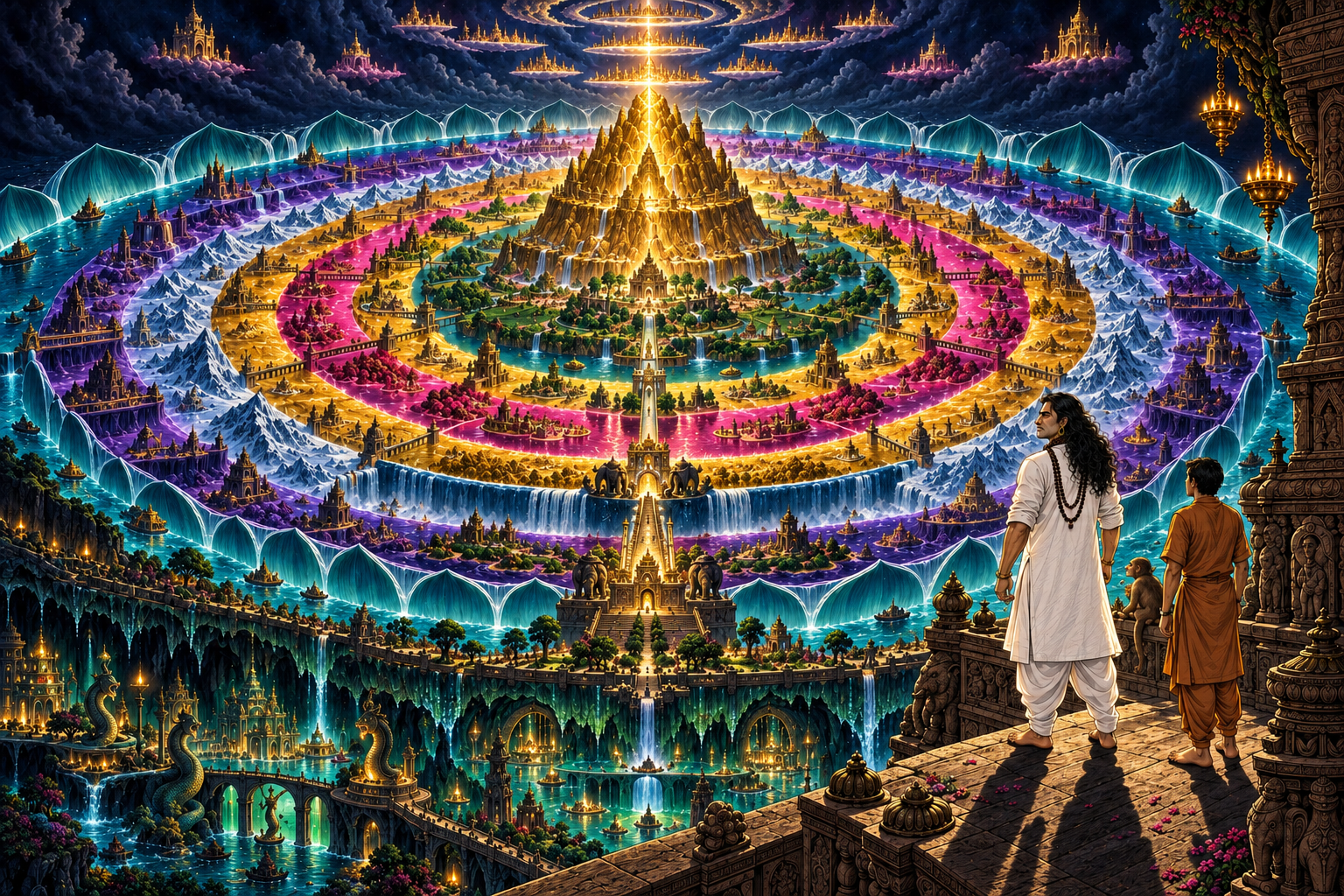
Bhāgavata Purāṇa cosmography. One chosen textual map—not a mixture of interchangeable traditions. The colours are our visual navigation system, not colours prescribed by the verses.
The circular landscape
Centre: Meru in Ilāvṛta, within Jambūdvīpa · 5.16.7. Equal-width bands simplify the topology; distances are not to scale. Decorative lotus petals have no claimed canonical count.
The vertical worlds
Shown top → bottom. This is a separate arrangement, not the seven concentric lands and not a chakra diagram.
- SatyaUpper world
- TapaUpper world
- JanaUpper world
- MaharUpper world
- SvarUpper world
- BhuvarUpper world
- BhūrTerrestrial plane
- AtalaLower world
- VitalaLower world
- SutalaLower world
- TalātalaLower world
- MahātalaLower world
- RasātalaLower world
- PātālaLower world
The lower worlds include elaborate homes and gardens. They are not interchangeable with Naraka: 5.24.8.
The route through this chapter
- Page 1 · Govardhan → threshold
The son’s grief has distanced him from his mother. He asks for another evening with his father. The four companions enter the Court; he loses track of the return doorway among its arches. - Page 2 · The balcony and the Keeper’s globe
Meru establishes the landscape beyond the balcony. A close view through the globe reveals one frozen city. Its guardian’s promise tempts the grieving son. - Page 3 · Views from the same balcony
Guruji explicitly tells the son that the Keeper cannot undo a death. The seed in luminous openness and the shore with Kuśa-inspired grass are views beyond the glass, not additional journeys. Their growth reveals what the paused city has lost. Void remains distinct from a geographical region. - Page 4 · Beside the Keeper’s enclosure
The Keeper asks how he can protect people without controlling their time. After Guruji answers, he offers the globe. The son relinquishes his own plea. Guruji releases the enclosure; the city and underlying geography survive. - Page 5 · A lower-world garden seen in section
The vista evokes 5.24.8 without asserting which named lower world contains the invented city. Life resumes inside the released enclosure, not throughout a previously frozen universe. - Page 6 · Return to Govardhan
All companions return to the courtyard. The watch stays stopped and the father remains dead. The son chooses to sit with his mother tomorrow. Having seen Chunmun choose the arch before it opened, he wonders whether she already knew the Court. This chapter has not toured all seven regions or all fourteen worlds.
What makes this world coherent
- Every large vista retains a central golden Meru and recognisable concentric land/ocean organisation. Cutaway views use ordered levels; no arbitrary floating duplicates.
- At a threshold, geometry appears first in a reflection, then in the inhabited landscape. Colour shifts reveal relations rather than changing where a place is.
- The same region keeps its colour, topological position and characteristic ecology when the camera moves. Luminous kuśa grass and a golden outer lotus give specific details.
- Psychedelic means perceptual transformation: nested patterns, prismatic light, depth inversion and recursive scale. No drug mechanism or practice instruction is introduced.
- The human watch/loss story continues through these ordered regions. The climax releases the invented enclosure; it does not destroy, reorder or permanently freeze the Purāṇic universe.
Textual boundaries and unresolved differences
- Horizontal land/ocean rings and vertical lokas are different structures. Do not turn the seven dvīpas into seven planets or seven chakras.
- The schematic compresses distance. Repeated doubling in the selected text is a design constraint for scale, not reproduced by the equal-width drawing.
- No modern kilometre conversion is applied. The inspected English page for 5.16.5 says one million yojanas, while 5.16.7 and 5.20.2 use 100,000 in their comparisons; this internal presentation discrepancy remains unresolved.
- Viṣṇu Purāṇa II.2, Wilson translation, lists curds before milk, unlike the selected Bhāgavata passages. This edition follows Bhāgavata, not a merged universal Purāṇic map.
- Lower worlds are not interchangeable with Naraka. The selected 5.24.8 explicitly depicts rich inhabited environments.
- Concentric fields, lotus structure and an axis are source-based motifs. Iridescence, decorative petal counts, nested optical geometry and the Court of Time are artistic additions, not a canonical Śrīcakra or a newly discovered scriptural yantra.
- Do not identify the book’s conscious Void with an ocean, a ring or a named loka. It remains a distinct metaphysical theme in the authored story.
- The Keeper’s frozen kingdom is an invented enclosure within the imagined Court, not a scripturally named realm. It must never be labelled Sutala or attributed to Bali.
- Guruji’s relation to the universal-body motif is the comic’s fictional interpretation. These verses are not historical testimony that he is the Purāṇic deity.
- The art evokes selected motifs; precise counts and names are guaranteed by the editable schematic, not by treating generative illustrations as accurate maps.
Comparison inspected: Viṣṇu Purāṇa II.2, H. H. Wilson translation (1840). Different sea ordering recorded; Wilson’s editorial footnotes are not the Purāṇa’s own words.
A source-linked schematic and fictional world-design grammar; not a measured astronomical model or a complete critical edition.
Selected primary passages · 13 source links
A. C. Bhaktivedanta Swami Prabhupāda translation at VedaBase, Sanskrit checked beside the selected translated verses. Verse imagery is distinguished from commentary and from modern astronomical claims.
- Bhāgavata 5.16.5 — Lotus and central circular region
- Bhāgavata 5.16.7 — Golden Meru at the centre
- Bhāgavata 5.20.2 — Jambū, salt water, Plakṣa; nested widths
- Bhāgavata 5.20.7 — Plakṣa and Śālmalī; surrounding oceans
- Bhāgavata 5.20.13 — Kuśa and ghee; luminous grass
- Bhāgavata 5.20.18 — Krauñca and milk
- Bhāgavata 5.20.24 — Śāka and curds
- Bhāgavata 5.20.29 — Puṣkara and freshwater; golden lotus
- Bhāgavata 2.5.38 — Bhūr through Mahar; universal-body correspondence
- Bhāgavata 2.5.39 — Jana, Tapa and Satya; universal-body correspondence
- Bhāgavata 2.5.40-41 — Seven lower worlds; universal-body correspondence
- Bhāgavata 5.24.7 — Seven named lower worlds
- Bhāgavata 5.24.8 — Lower-world palaces, gardens and households
Read the full narration and dialogue
1. One more evening
Panel 1
After Father died, Mother and I barely spoke. I brought his stopped watch to Guruji.
Panel 2
The son: I never said goodbye. Give me one more evening with him.
Panel 3
Guruji: Come. Someone has found a way to keep an evening forever.
Panel 4
We entered the Court of Time. I lost our door among its arches. Chunmun and the dog followed.
2. The Keeper’s promise
Panel 1
Our host held a glass globe. An entire city lay inside it.
Panel 2
Through the glass: a mother and child, a potter, a river. Nothing moved. Even the falling rain had stopped.
Panel 3
Keeper: I stopped time. No more goodbyes.
Panel 4
He stood outside his spell. I envied him. Yet none could answer him.
3. The cost of forever
Panel 1
The son: But can he bring back someone who has already died?
Panel 2
Guruji: No. He has stopped their future, not undone their past. Look: even the Void allows a seed to grow.
Panel 3
Outside the glass, life kept changing. Inside, the girl could never take her next step. An endless evening—and no tomorrow.
Panel 4
He turned toward the globe. His shadow rose. “Will the city survive?”
4. Let them live
Panel 1
Keeper: If I open it, they can suffer. They can die. How do I protect them then?
Panel 2
Guruji: Stand beside them. Let them have a tomorrow.
Panel 3
The Keeper offered the globe. I let go of my plea. “Let them live.” Guruji opened his hand.
Panel 4
The glass broke. The city held. A drop fell; the child moved. I was still afraid. Now I knew what we were saving.
5. The way home
Panel 1
The city rejoined the living worlds. Its people resumed one interrupted evening. The Keeper heard their voices again.
Panel 2
Guruji: You are still their Keeper. Go to them.
Panel 3
Chunmun went straight to an unlit arch. Only then did it open onto our courtyard.
Panel 4
His shadow still lay over the worlds. I followed him home.
6. Tomorrow
Panel 1
Back in Govardhan, the watch was still silent. My father was still dead.
Panel 2
Guruji: You can miss him and still live. The two are not enemies.
Panel 3
I kept the watch. Tomorrow, I would sit with Mother. We could speak of him—or simply eat together.
Panel 4
Chunmun ate as if it had been an ordinary walk. “Guruji… has she been to the Court before?”
Behind the chapter: sources and art
A psychedelic illuminated graphic novel: engraved detail, ordered land-and-ocean fields, a central golden Meru, and separate vertical worlds. The source-linked schematic supplies the precise names and counts; generated art evokes selected motifs. Guruji’s established likeness is retained; the son and Keeper are fictional.
Pages 1, 2, 4, 6: Original fictional plot: grief, Keeper, stopped watch, frozen kingdom and liberation. No reported Awakener incident is reenacted.
Pages 3, 5: Inspired by Awakener Russian PDF pp. 364–371: Time/Void continuity, forms arising and returning, Time experiencing through living forms. All narration is a new literary formulation, not a Guruji quotation.
Pages 1, 2, 3, 4, 5, 6: Bhāgavata Purāṇa 5.16.7, selected 5.20 passages, 5.24.7–8 and 2.5.38–41 supply Meru, concentric land/ocean structure and distinct vertical worlds. The Court, colour scheme, perceptual transformations and Keeper’s city are authored additions, not canonical places. Other temporal traditions remain distinct.
Pages 5, 6: World history is not reversed. People retain agency. Chunmun’s identity remains an authored mystery, not an unsupported deity attribution.
Independent research and comparison data · Chapter text and source-linked world grammar
Text-free art generated with the built-in image tool; separately editable English SVG lettering. No source-book pages, film stills or lyrics reproduced.